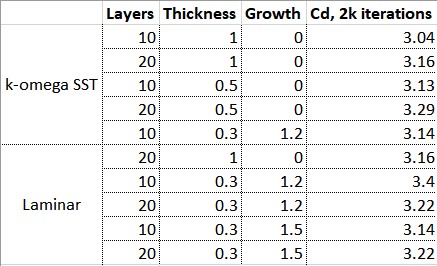
I have run several simulations now varying only the boundary layer inflation settings. This has taken several community hours, especially because they take a long time to converge. So hopefully it will be useful to more than just me. And someone can hopefully maker better sense of this! I have limited most of the runs to 2k iterations though they need 3k+ at the manual relax setting. My primary interest is drag coefficient (Cd).
I had the unhappy realization halfway through that I should be setting the turbulence model to laminar, rather than the automatic k-omega SST. At 20 cells 1 thick and 0 growth this did not change Cd in 2k iterations (see screenshot of table), but at 10 cells 0.3 thick 20% growth the change was fairly pronounced.
It is notable that SimScale does not allow more than 20 boundary layers, so testing 100 cells perpendicular to the wall is impossible. The auto boundary layer setting in the laminar model also includes the boundary layer growth rate found in turbulence models. This confuses the issue somewhat for me. Whether turbulent or laminar flow, the grid in SimScale appears designed to increase in size as well as by count, so there are two effects on the grid that change the Cd results.
With the grid set to 10-20 cells, 0.3 thick and 20% growth (and relax factors set to manual [P 0.3, U 0.7]) the simulations begin to stabilize around 2k iterations, but Uy and subsequently Cd continue to fall very gradually past 2.5k. I will be continuing these two runs specifically to try and get Cd to stabilize.
The main problem at this point is that I am unsure how to determine when I have reached grid independence through the combination of cell thickness, number, and growth rate. The following gives me the most confidence since Cd is consistent at 1.2 and 1.5 growth:
20 layers, 0.3 thick, 1.2 growth rate: