Hi @dbailey,
there is no need (other than if you want to investigate the stresses on the contact zone near the cylinder), to use and actual cylinder placed at different positions in the model in order to insert loads at specific areas of the table.
You can use you cad tool to split the table surface on those locations where you would later want to add a load. The best would be to include all different locations in to one CAD model (this would save you a lot of time since you only need to create one mesh and basically one simulation, it also makes the results more comparable). I used this technique to imprint the contact zones from the legs to the table in the simulations without legs (static on feet - plate only):
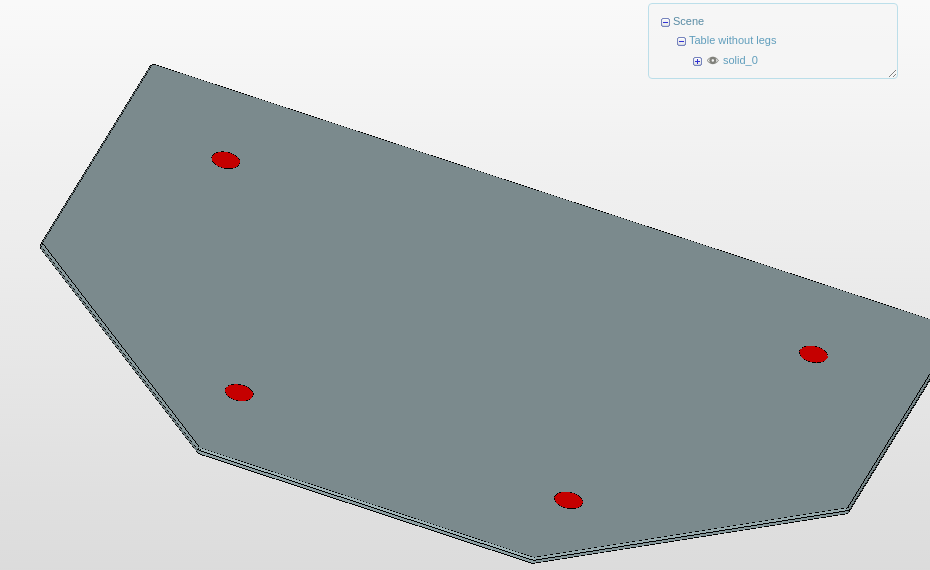
The problem you encounter with the sliding table is a common error in a static FEA analysis. In your case the table was resting on the feet with a sliding contact. This constrained its motion in Z-direction but left it totally unconstrained in X- and Y-directions. Intuitively, this should not be a problem. As there is no force in X- or Y-direction, the table should not move in any of those directions and thus does not need a fixation.
The problem: if you use a direct solver for the linear system, it will fail since it can’t invert the matrix. This will always happen if you can move a part of the system without using any force.
You can in theory circumvent this matrix inversion problem by using an iterative solver, which does not need matrix inversion. The problem with this is that for a numerical analysis is, there is never exactly zero forces, rather something like 1e-18. So if you would use an iterative solver, it would probably work, but most likely your table would slide 100m away.
To solve this issue we introduced a constraint called elastic support. It basically allows you to anchor parts of the system with soft springs such that it does not cause the singularity issues and still is soft enough to not influence the results. I used this also in the simulation static on feet - contact with feet.
Best,
Richard