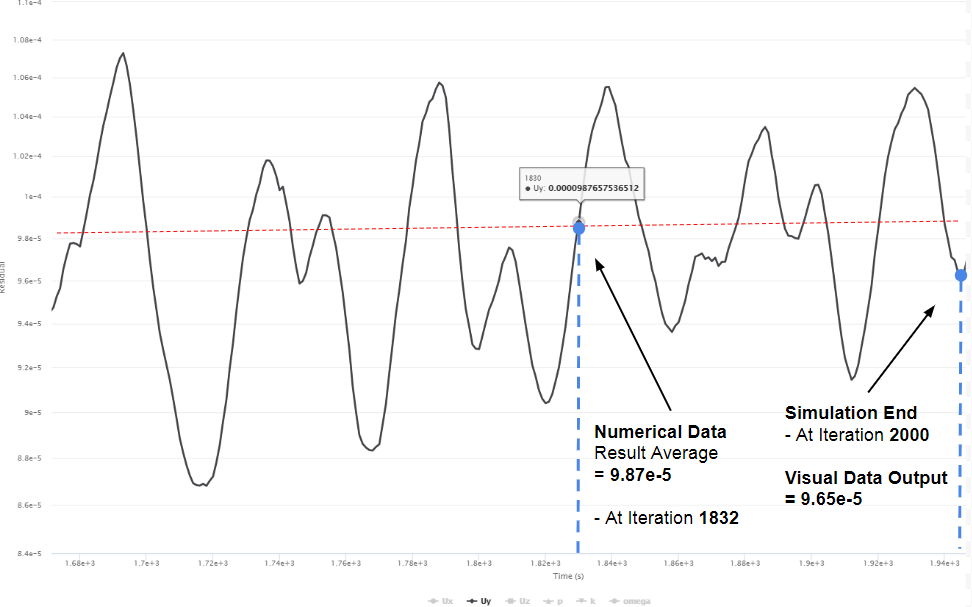
I have had the pleasure of using the ORSI program created by Dale. It is an excellent tool to verify stability in simulated results though its use of a moving average. By analyzing the results from this program you can extract two very important things.
-
1st - After the first simulation is run, the average value that is being oscillated upon is found at a specific iteration. This means that using ORSI after a simulation run with a write interval of 2000, the program will reveal that 1% stability was achieved at iteration 1832 for example. This allows you to set a much shorter write interval, at iteration 1832, for succeeding runs and saves many core hours in the process.
-
2nd - Using this specific write interval we can then match, as closely as possible, the visual results obtained in the solutions field, with the numerical average of results. For example, let’s say the average of the numerical results is 9.87e-5. This value was obtained at iteration 1832 yet the write interval for the visual results that will be shown in the solutions field is at the preset value of 2000. This means that the visual results will not exactly match the numerical average of the results, leading to possible false conclusions based on visual data. Using the ORSI program we can set the exact write interval need, and be confident that both our data sets match and are verified as stable. Very Useful!!!