
Hello @moustafa_hamed ,
I just wanted to add a few observations on top of what my colleague @kaany called out. Take this for what it is worth, as I have plenty of experience in race vehicle aero (but not so much w/ open wheel cars). I will not comment on your design, as that is an exercise left up to you and your team using the SimScale post-processing tools (or Paraview if you are feeling sporty).
1.) I would “rebudget” your mesh a bit to coarsen out in the far-field sizing away from the car and use some wake refinements to capture off-body flows near the vehicle. This is particularly important near aero-devices such as the wings, side pods, and diffuser. It’s really about striking the right balance in order to optimize accuracy and throughput. I would suggest using the refinement box feature to create some zones and try to keep it simple. You could likely also pull 1-2 prism cells away from all surfaces that are not aero devices/airfoils such as the ground, cockpit, and body.
2.) The industry standard CS convention for reporting forces/moments is as shown:
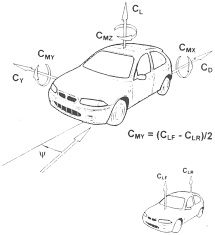
X: Drag
Y: Side
Z: Lift
Centered on vehicle centerline and mid-wheelbase at the ground plane. This will make the CLf and CLr very easy to calculate (SimScale reports these for you). For race aero, the balance is as important as the overall magnitudes, as it will directly affect vehicle dynamics (handling, braking). As mentioned, your coefficient velocity does not match your vehicle speed, which will also cause some absolute error.
3.) Ride height is critical. 1-2 degs in pitch and a few mm in ground clearance can dramatically affect your aero numbers. This is especially true when wings are involved. Ensure that you are running the same ride configuration as you expect to see on track (or in tunnel).
4.) You can get better convergence (and accuracy) if you treat the contact patch area geometry as directed in this post.
5.) Don’t hesitate to include heat exchangers in your model where appropriate using the porous region approach. This is important if you have heat exchangers affecting the flow in your sidepods, open air, or ducted in the body.
This is probably enough for you to chew on for now. Keep up the good work and keep us updated on the progress.
Thanks,
–Nolan