Hi everyone,
Just a quick update. So basically my approach has been really wrong the whole time. The idea was there but the initial guess on what is wrong was well… wrong to say the least. Initially I guessed the numerics were incorrectly set and not enough consideration was given to adjusting the errors within the simulation of the aerofoil. After this was exhausted with the introduction of the automatic relaxation factors, my next guess was the “3D” nature of the 2D simulation. I’m unable to effectively create a true 2D simulation but I figured cutting into a 3D diamond aerofoil like most other 2D via “3D” simulations have done would be alright. I guessed again that it was this that was the issue, turns out it wasn’t.
The core issue after many months of on and off on the project (if you notice the date) was a simple issue with the solver chosen. Dylan has stated in this post why the solver I used (rhoPimpleFoam) was unable to resolve the strong shocks I was looking to re-create in order to verify with the theta beta mach shock graph. In short, rhoPimpleFoam was missing a transonic formulation and instead the laminar transient density based solver (rhoCentralFoam) only can be used. The results produced are now much more workable and it is free of the inherit problems that this thread initially encountered. I’ve went ahead and simulated and here is a screenshot of the initial results.
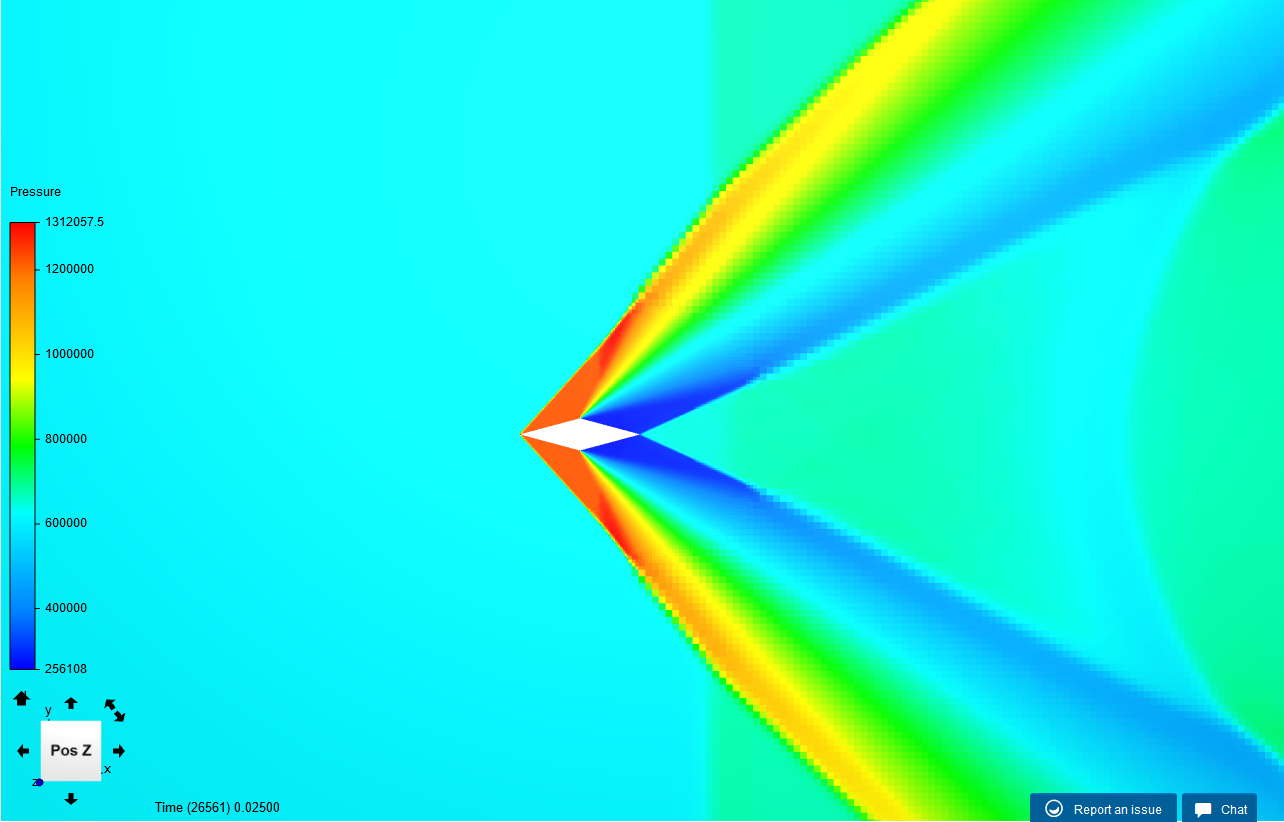
The strong shocks have shown up and are somewhat behaving as expected. The current shock wave angle here is 48 degrees while the theta beta mach shock graph states that for this speed (Mach 2 or 612.54 m/s) the shock angle should be 45 degrees. The simulation has not truly converged and a simple increase in end time should allow it to reach the correct shock angle.
I will continue to work on this and ideally run several different angles of the diamond aerofoil to validate the shock angle produced once I’ve obtained the correct setup for this particular case.
Thanks everyone for all the help previously and currently.
Cheers.
Regards,
Barry
EDIT: I have made a calculation error in the input values. As mentioned earlier, I deduced the inlet velocity for Mach 2 as 612.54 m/s. That is incorrect. The actual value should be 686.12 m/s. Regardless, that incorrect input value (Mach 1.785) should have produced a shock angle of approximately 52-54 degrees which from the figure I posted, is clearly not the case and at best 7% off and at worse 11%. While relatively speaking this may be acceptable to some degree, but there has been simulations where the the margin of error is less than 1%. I am continuing to work on the issue and am making some progress. Will update as accordingly.