Hi everyone,
While I’m still wrapping up another compressible flow project, I was doing some research on the solver used for this simulation. From what I’ve gathered, the solver we are using (rhoSimpleFoam) does not work for transonic steady-flows. Why this is the case I am not too sure, but I’ve read that it might have to do with the fact that rhoSimpleFoam is an uncoupled solver and this means that at transonic to supersonic flow, the solution will be unable to converge regardless of numerical dampening.
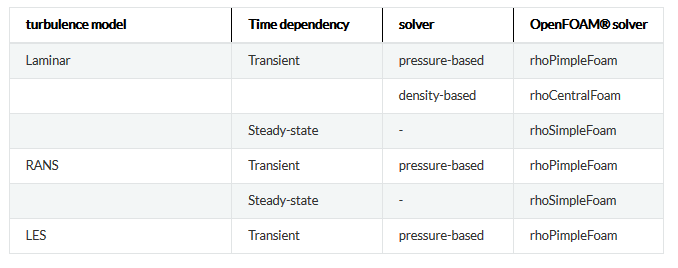
The recommended course correction would be to use a transient solver, namely rhoCentralFoam. However, turbulence effects will be negated as rhoCentralFoam is laminar. As for rhoPimpleFoam which is a transient solver with turbulence, I have not investigated the usage of it for transonic/supersonic flow.
Obviously, usage of a transient solver will result in less efficient solving due to the small timesteps involved and the need to adhere to courant numbers of less than 1. In addition, if one wants to use fine grids, like in this case (in order to determine the drag on the pod) then the computational cost increase will be substantial.
Sounds good, so all I have to do is change solver and just run a transient simulation? Well I would do so, but there several things I still don’t understand and maybe someone can enlighten me.
- If rhoSimpleFoam is unable to converge for transient/supersonic flows, then why is this paper able to do so? I suspect that they coupled their own formula’s to the rhoSimpleFoam to allow steady-state convergence, but it isn’t clear to me. Can anyone confirm?
- What does the transonic option in the numerics do? Provide a coupled equation?
- What is the difference between a pressure-based and density-based solver? It seems like for high mach no flows, pressure-based solvers do not converge well for some reason. Is this observation even correct?
- The usage of implicit and explicit schemes in this context, along with how they are expected to behave. I am unable to understand the implications of the usage of either methods. Generally it seems that implicit schemes are better for compressible flows, but why?
So many questions and no real answers as the documentation relating to transonic/supersonic flow beyond very basic 2D geometries is very limited. Even more limited is documentation for steady-state solutions for such high speed flows.
For everyone’s reference, here is the list of solvers
Back to more head cracking.
Cheers.
Regards,
Barry