
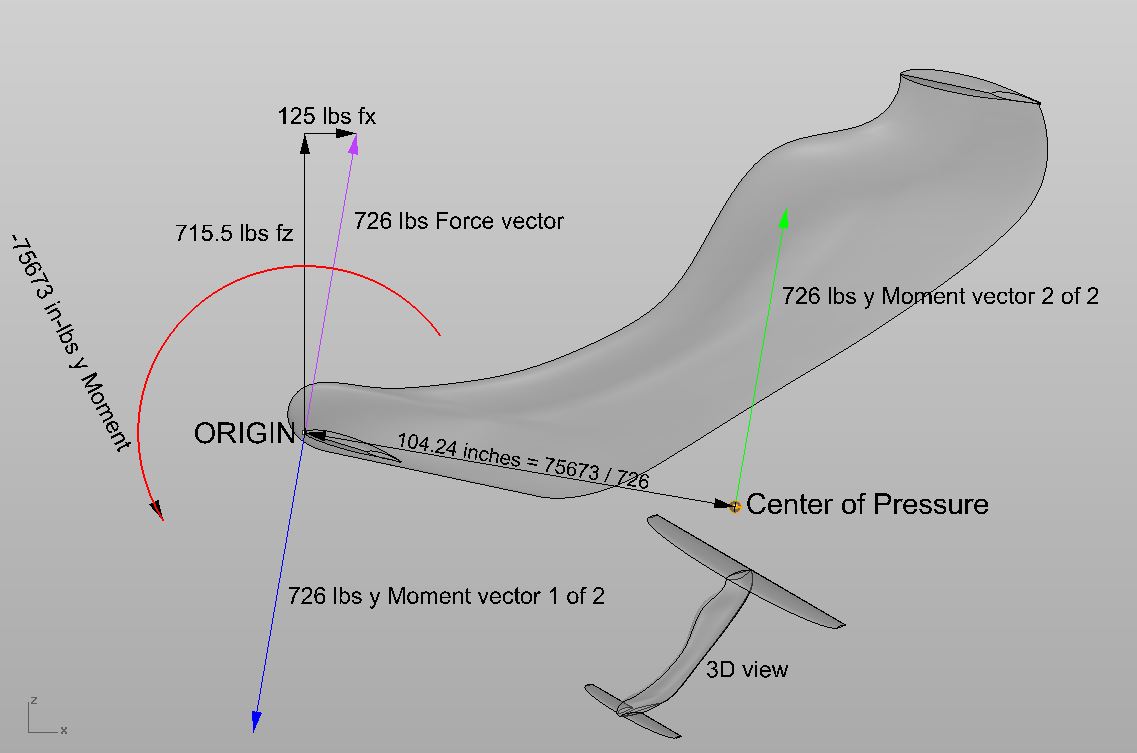
A manual (graphical in CAD program) method for the case of two orthogonal forces (say fx and fz) acting on a point and a moment (say ymoment) about that point in an axis orthogonal to the plane of the two forces, I believe that you can determine the CP positon as follows (a general formula to the below is much more difficult due to quadrant issues of the force vector and the polarity of the moment but that should be no sweat for the programmers at simscale, and with a little further application of this method, solving for a true 3D CP position would be a great feature to add to the Forces and Moments output  ):
):
- Determine the force vector of summing the two forces whose force magnitude is F.
- Offset this force vector by a value of abs(ymoment/F). Pay attention to polarity of ymoment to make sure that you offset the force vector on the correct side.
- Thats it.
The below image should help out with my poor explanation. fx (drag) fz (lift) and ymoment (pitching moment) come right from your simulation force plot output as pressure values (in my case I can ignore viscous and porous values as they are so small). Once you convert the ymoment into two force vectors as described above, the purple and blue force vectors cancel each other and you are only left with the green force vector at the CP.
My ulterior motive for posting this is to get feedback so that I know I did this correctly , its just that before I did the CFD on this case, may brains CP calculator would not have placed the CP as shown…